
What happens when a refrigeration system fails (and how to prevent it)
A refrigeration system never “just fails”. It fails with stock inside, or it fails mid-shift. And it fails right before a customer audit. In food & beverage, pharmaceutical, medical storage, and process manufacturing, a 2-degree drift can wipe out thousands of dollars in product. This is why Commercial Refrigeration Maintenance is risk control, not admin.
What actually happens when refrigeration fails
When cooling drops out, you get a chain reaction.
Product risk shows up first.
Temperatures climb, condensation starts, quality shifts before it’s obvious. That’s a rejected dairy batch. A disruption to brewery cooling systems, or quarantined medical refrigeration storage.
Compliance gets dragged into it.
If you can’t show temperature control and maintenance history, you can’t prove you managed the risk. That’s how sites fail audits.
Damage escalates in the background.
Dirty coils drive head pressure up, fans struggle, compressors run hotter and trips become more frequent. That’s how you end up needing emergency chiller repair at the worst time.
Cost of refrigeration system downtime: where the money goes
The engineer’s invoice is the visible part. The higher costs are usually:
- Lost or downgraded stock.
- Labour standing around and missed production.
- Rush logistics and missed delivery windows.
- Energy waste from short-cycling, poor heat transfer, and running under fault conditions.
- Emergency parts sourcing when lead times are tight.
If one failure can scrap a pallet, it can erase the cost of a year of preventative work.
Common causes of commercial fridge failure
Airflow and heat transfer (the #1 culprit)
- Condenser coils clogged with dust/grease.
- Evaporator coils icing up.
- Fans slowing down, failing, or pulling uneven airflow.
- Hot air recirculating in tight plant rooms.
This is why bakery cooling system servicing and other high-dust environments need more frequent cleaning.
Refrigerant faults (performance + compliance)
- Small leaks reducing capacity over the weeks.
- Poor charge after previous works.
- Vibration damage on joints and supports.
If you’re managing F-Gas compliance in the UK, a leak is a breakdown risk and a compliance risk.
Electrical and control issues
- Loose terminals causing heat and nuisance trips.
- Worn contactors/relays.
- Sensor drift and probe failure.
- Defrost faults leading to ice, blocked airflow, and “mystery” warm rooms.
Chillers, glycol, and process cooling
On industrial chillers and glycol cooling systems, failures often start in the loop:
- Pump wear, seal issues, or air in the circuit.
- Blocked strainers and poor flow.
- Incorrect glycol concentration (freeze risk, corrosion risk, reduced heat transfer).
This is where industrial glycol system maintenance pays for itself.
What to do in the first 60 minutes
Move fast, but don’t make it worse.
1) Protect stock and evidence
Shut doors.
Reduce traffic.
Start a temperature log.
Segregate “at risk” product.
2) Reduce heat load
Pause the hot product going into cold areas.
Minimise door openings.
Check obvious airflow issues (ice build-up, fan not running, blocked vents).
3) Give the engineer what they need
Time of first alarm.
Trend of temperature.
Any recent works or power events.
Controller/BMS alarms.
Good data turns it into diagnosis, not guesswork.
Preventative maintenance for industrial chillers (and everything attached to them)
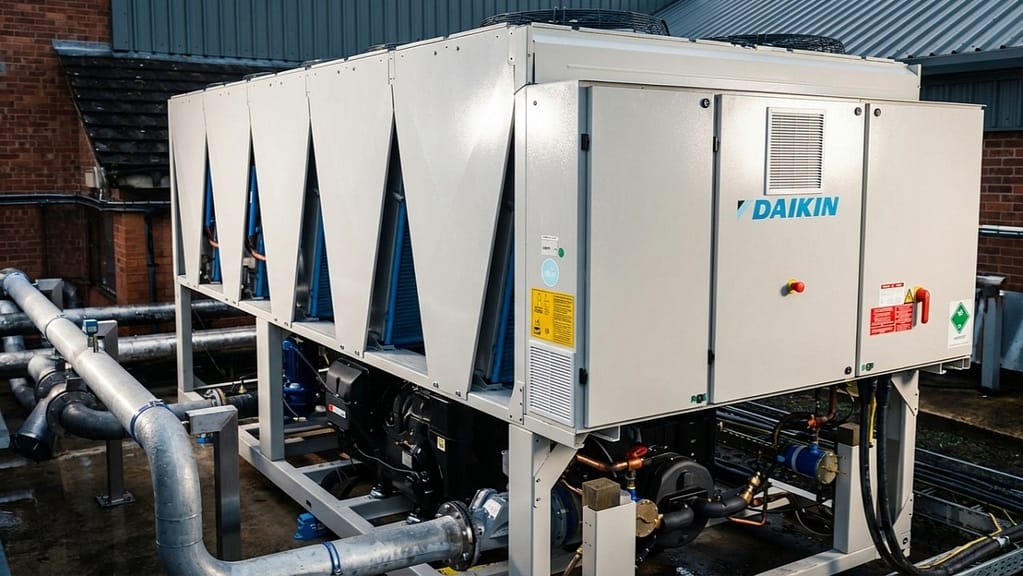
Preventative maintenance for industrial chillers is not “check the chiller and leave”. It’s the whole system: heat rejection, electrics, controls, and the process loop.
The high-ROI checks that stop failures
- Coil cleaning and airflow checks (especially in bakeries and dusty production).
- Leak checks and performance readings to meet F-Gas requirements.
- Electrical inspections: terminals, contactors, overloads, recorded readings vs baseline.
- Controls and sensors: probe accuracy, defrost function, alarm setpoints.
- Glycol loop health: concentration, flow/pressure, strainers, pump condition.
So what? These checks prevent:
- Hidden energy waste.
- Repeat nuisance trips.
- Product loss from sensor drift.
- “Sudden” failures that were actually building for months.
Document it like an auditor will read it
Maintenance logs, readings, and corrective actions should be clear enough that someone outside the site can follow the story. That protects QA teams, compliance officers, and you.
When you need 24/7 emergency refrigeration repair
Even a strong PPM won’t stop every failure. Parts age, Sites change, Power supplies misbehave. The goal is to avoid the double-hit: breakdown + chaos.
If you already have service history, an asset list, and a partner who knows your site, the call-out is faster and cleaner.
Pharmaceutical cold room PPM, dairy maintenance, and process cooling audits
Different sites break in different ways. That’s why good providers adapt the plan:
- Pharmaceutical cold room PPM prioritises sensor accuracy, alarm testing, and evidence.
- Dairy refrigeration preventative maintenance focuses on hygiene, airflow, and uptime in peak production windows.
- Process cooling reliability audits catch “soft failures” (flow, heat transfer, drift) before they become scrap and rework.
This approach also applies to brewery cooling systems and biotechnology cold rooms where stability and logging matter.
Stop relying on luck
- The real cost is downtime + stock + compliance exposure (not just the call-out).
- Most failures start small: airflow restriction, electrical heat, or a slow leak.
- A tight PPM plan catches faults early and proves due diligence.
- If you do need 24/7 emergency refrigeration repair, preparation decides how bad it gets.
If you’re one fault away from a stock write-off or a failed audit, it’s time to tighten the basics.
Speak to Beswick Refrigeration Services (BRS) about Commercial Refrigeration Maintenance, preventative maintenance for industrial chillers, and a site-specific plan that keeps you compliant and running.


