
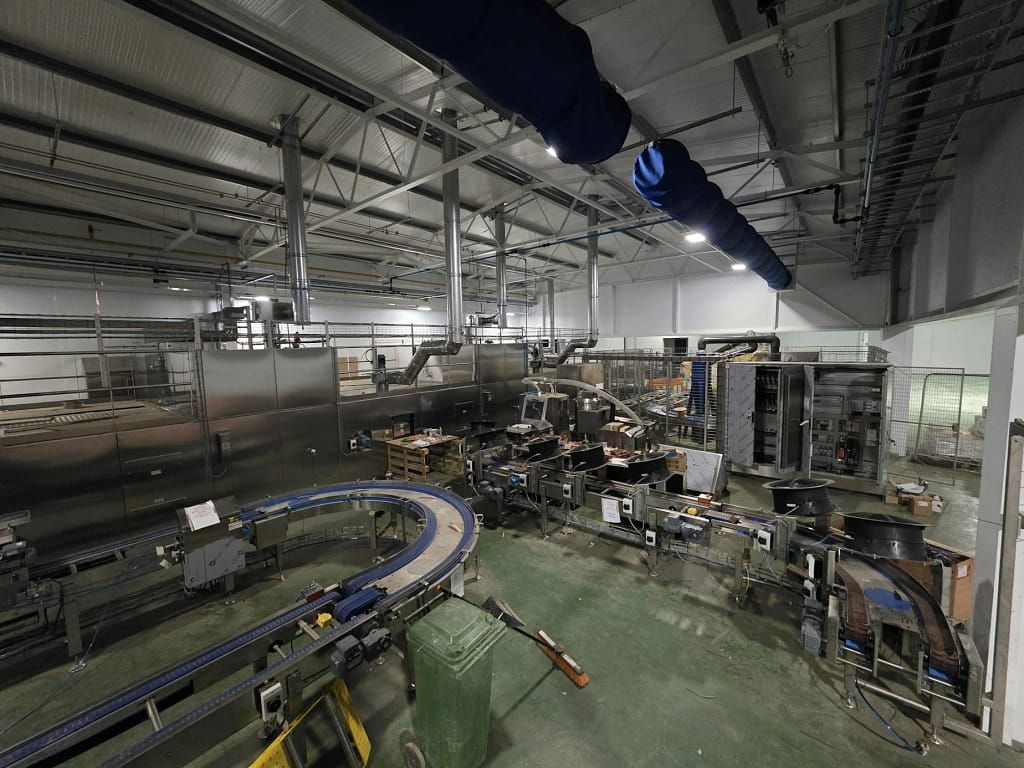
Gas-fired heating carries three problems that engineers at food production sites understand well.
First, a single heat source is a single point of failure. When that generator goes down, hot water generation stops, hygiene standards are at risk, and production time starts disappearing. Second, gas-fired plant carries carbon and fuel cost exposure that gets harder to justify as energy targets tighten. Third, and most often ignored: you cannot manage what you cannot measure. Many sites run on assumptions about system performance rather than actual data.
Process cooling systems for food manufacturers have moved well beyond simple chilled water loops. The better-engineered solutions now integrate heating, cooling, heat recovery and energy monitoring into a single controlled platform, producing the measurable performance data that engineering and compliance teams need. This article sets out what that shift looks like in practice, and how BRS’s process engineering team delivers it for food and drink sites across the UK.
Why Traditional Hot Water and Heating Plant Lets Food Sites Down
The failure mode for most legacy gas-fired heating systems follows a predictable pattern.
Production demands vary across shifts. Heating demand peaks, drops, and spikes unpredictably. A fixed-output gas boiler either runs flat out and wastes energy at low load, or gets stretched at peak demand and generates the thermal instability that causes quality and hygiene problems downstream.
The single-source problem is compounded by the visibility problem. Most sites carry out maintenance on gut feel and engineer experience. A temperature reading here, a pressure check there. But without continuous monitoring aligned to a standard like ISO 50001, early indicators of energy loss, refrigerant drift or thermal degradation are easy to miss until something fails.
Research published by Penmann in March 2026 confirms that refrigeration and cooling systems represent the single largest electrical load on most food and beverage manufacturing sites. The engineering decisions made around those systems determine a site’s energy cost base, its carbon exposure, and its ability to hold production uptime across the year.
What a Heat Pump Energy Centre Actually Looks Like
The term “energy centre” describes a design approach rather than a single product. The goal is to combine heat generation, heat recovery, thermal storage and performance monitoring into one coordinated system, replacing the fragmented plant that most production sites have accumulated over decades. BRS’s process and utility systems capability covers the full scope of this work, from pipework design through to commissioning.
High-temperature electrified heat generation
Inverter-driven air source heat pumps operating at high temperature output can deliver hot water above 65 degrees Celsius, which covers the hygiene and process requirements of most food production environments. The heat pumps are sized and configured to handle the variable load profile of a production site rather than a fixed residential demand, with buffer vessels to stabilise inputs and outputs and minimise peak electrical draw.
This replaces the gas boiler as the primary heat source. Gas use drops significantly. Carbon exposure drops with it.
Distribution, recovery and built-in redundancy
A well-designed system distributes heat through a skid-mounted low-temperature hot water ring main. Multiple end points draw from it simultaneously: space heating for production areas and raw materials intake, heat recovery from air compressors, process hot water for production lines, and prover or oven-related process loads in bakery environments.
Modular variable-speed pump sets allow the system to respond to changing loads throughout the day. Flexible valve arrangements and redundant pumping capacity mean a component failure does not take the whole system down. Maintenance access improves. Planned downtime replaces unplanned breakdowns.
ISO-aligned energy monitoring
The monitoring layer is where the engineering case becomes the compliance case. Measuring equipment aligned to ISO 50001 and ISO 50006 tracks energy flows and consumption across every point in the system. This connects directly to BRS’s energy saving enhancements service, which gives sites a structured starting point for identifying where energy is being lost and what the upgrade priority should be.
Engineering and compliance teams can see centralised availability of measured data, early identification of energy loss, permanent monitoring of process variables, and full transparency on fluid and heat flows at any given time. This is the difference between “we think it’s efficient” and “here is the evidence.”
What the Engineering Evidence Tells Us
A review published by Cascade Energy found that industrial heat pumps can achieve up to 70 percent reduction in energy consumption compared to conventional heating and cooling systems in food and beverage environments. COPs in real food production applications now range from 1.6 to 5.8 depending on configuration, and the shift toward natural refrigerants continues.
For a food production site planning a capital project, the investment case rests on three factors: lower operating cost over the life of the system, reduced carbon exposure as energy targets tighten, and the resilience and visibility that compliance and QA teams require. All three sit in the same engineering design decision.
How BRS Approaches Process Cooling and Heating Projects
BRS has delivered process plant engineering for food and drink manufacturers, pharmaceutical sites and wider industrial environments for over 40 years. The process engineering team, based at the Rugeley facility, designs and builds systems from specification through to commissioning.
Projects at BRS follow a turnkey model. That means one team handles design, fabrication, installation and commissioning, with no handoffs between a design contractor and a build contractor. For clients, this removes the coordination risk that causes programme overruns and specification drift on complex process engineering projects.
The scope typically covers process cooling systems, glycol cooling systems, hygienic process pipework, heat pump integration, skid-mounted utility packages and energy monitoring infrastructure. Where a site needs both service support and a capital project, the refrigeration service team and process engineering team work from the same building under the same brand.
BRS holds ISO 9001 and ISO 14001 accreditations and operates as an independent contractor, not tied to any single equipment manufacturer or refrigerant supplier. That independence matters when specifying refrigerants in a period where F-gas availability is tightening and low-GWP alternatives require careful assessment for each specific application.
Three Questions Worth Asking Before the Next Capital Review
If a process heating or cooling project is coming up for approval, the engineering case is straightforward. Three questions help frame it.
- Does your current system give you performance data that an auditor could verify, or are you relying on engineer experience and monthly bills to track energy performance?
- How would your site handle a primary heat generator failure during a production run? Is there built-in redundancy, or would it rely on emergency hire and reactive response?
- Are the refrigerants your current system depends on still going to be available at current cost in 2027 and beyond? The F-gas phasedown is accelerating.
BRS works with engineering managers, capital project leads and facilities teams at food and drink manufacturers across the UK to scope and deliver process engineering projects. If a heat pump energy centre, process cooling system or glycol loop is part of the next capital cycle, the process engineering team at BRS is worth speaking to early.


