
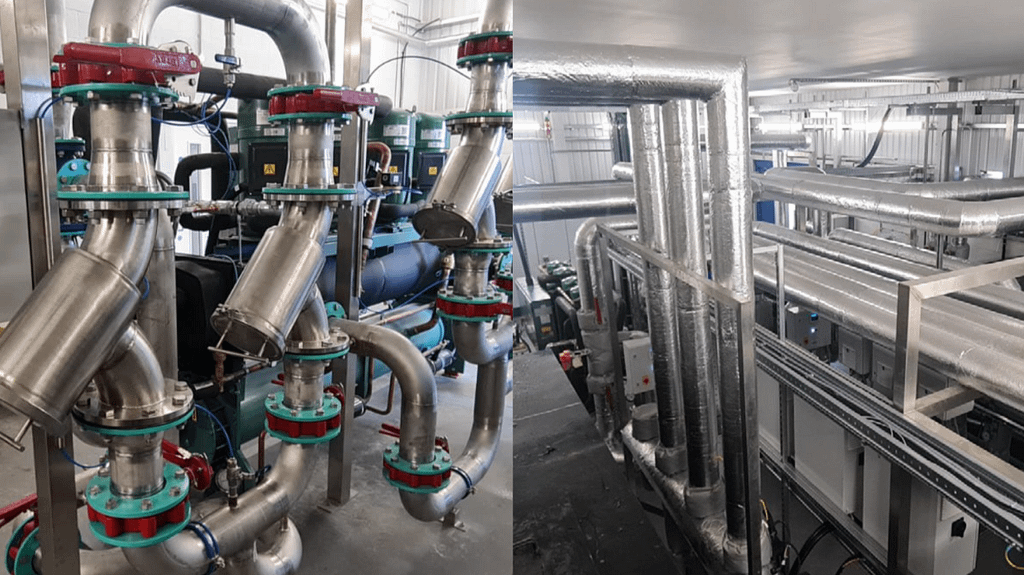
With physical layouts fixed and equipment selection still in progress, we were brought in to design, supply, and commission a fully integrated solution, custom-built to deliver performance within rigid site constraints.
The Client Brief
The cooling system needed to serve continuous-process moulding equipment with the following key conditions:
Cooling capacity: 800kW
Chilled water outlet temperature: +5°C
Chilled water inlet temperature: +10°C
Condenser water outlet temperature: +30°C
Condenser water inlet temperature: +25°C
Cooling fluid: Water
Ambient design condition: +35°C

Because building works were complete and internal plantroom dimensions were fixed, we had to engineer the system from the inside out, working backwards to fit performance around physical reality.
Technical Objectives
BRS was responsible for delivering a system that would:
Accurately size cooling loads based on real process conditions
Design and configure chillers, cooling towers, pumps, and controls
Integrate with existing mechanical and electrical infrastructure
Maintain system performance under all seasonal conditions
Provide redundancy and resilience to protect against production loss
Fit within restricted plantroom space without compromising serviceability

Key Challenges & Engineering Solutions
1. Limited Installation Space
The completed plantroom allowed no flexibility for expansion. BRS developed a compact layout using 3D spatial planning to maximise access while accommodating all required components. Key design elements included clearance zones, ergonomic valve access, and routing of pipework for long-term serviceability.
2. Cooling Tower Integration
External towers were required for condenser water heat rejection, but height restrictions were in place to preserve sightlines from the first floor. To address this, BRS installed an external ground-level pump set to manage return water flow from the towers to the internal buffer tank, avoiding the need to raise tower height.
3. Sump & Pump Management
Low sump height presented a cavitation risk due to reduced net positive suction head (NPSH).
Sump outlets were relocated to the underside of each tower, increasing NPSH.
Optical level sensors were installed and integrated with VSD controls to adjust pump speed dynamically and protect against dry-run conditions.

System Resilience & Integration
Redundancy & Load Transfer
To maintain uptime, BRS designed the system with pipework bypass and changeover valves, allowing the new plant to offload demand from the existing system if required. This involved comprehensive pressure loss analysis and space-efficient valve placement.
Controls & Interfacing
The new system was engineered to interface with existing site control infrastructure. BRS developed a custom logic sequence for reliable communication between old and new equipment, ensuring coordinated control via the client’s building management system (BMS).

The Result
Delivered on time and fully commissioned, the system now provides:
800kW cooling at +5°C chilled water under +35°C ambient
Full third-party control integration
Future-proofed layout with ergonomic maintenance access
Redundant flow paths to protect against equipment failure
Cavitation-free pump operation with real-time sump monitoring
Compliance with architectural and spatial constraints
Want to explore cooling system upgrades on a live or constrained site? Get in touch with the team.


