
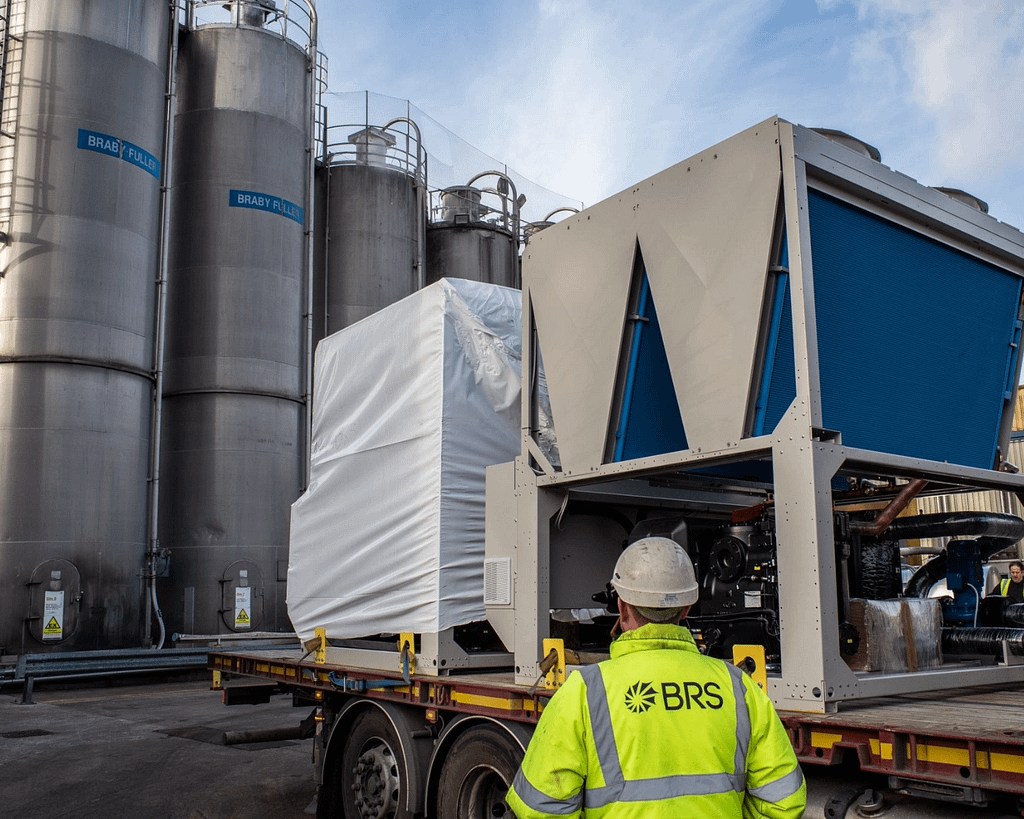
Engineering Better Systems: 4 Industrial Process Cooling Solutions Delivering Results in 2025
Most of the critical work in manufacturing happens behind the scenes. It is integrated into live operations, installed during tight changeovers, or delivered within strict building constraints. But while these systems are hidden, the problems they solve, like rising energy costs and inconsistent temperatures, are front and center.
At Beswick Refrigeration Services (BRS), we believe that bespoke refrigeration engineering isn’t just about keeping things cold; it’s about solving operational barriers.
In this project spotlight, we are sharing four industrial process cooling solutions delivered in 2025. From consistent temperature control to spatial restrictions, these case studies highlight how we solved complex engineering challenges for the bakery, plastics, food processing, and drinks sectors.
1. Glycol System Upgrade for Industrial Bakery Production
The Challenge: One of the UK’s leading bakery groups faced a critical issue: inconsistent raw ingredient cooling and a reliance on manual ice loading during peak output. Their aging infrastructure could not keep pace with volume growth, leading to temperature swings that threatened product quality.
The Solution: We delivered a complete glycol system upgrade designed for future-proofing. This involved installing three 260kW air-cooled chillers utilising modern R454B refrigerant. A sustainable, low-GWP choice. The system included a 2000L buffer tank and high-efficiency heat exchanger (HX) circuits with 3-port valves. Crucially, we integrated a central PLC for real-time monitoring.
The Results:
- Precision Cooling: Process temperature is now held strictly to ±0.5°C.
- Operational Efficiency: Manual ice loading was fully eliminated.
- Cost Savings: Significant reduction in energy and labor costs across shifts.
2. 800kW Bespoke Cooling System in a Fixed Plantroom
The Challenge: A plastics manufacturer needed a massive 800kW cooling capacity for new moulding lines. The constraint? The building was already complete, the plantroom was “boxed in,” and there were strict external height restrictions. Standard off-the-shelf solutions simply wouldn’t fit.
The Solution: We utilised an “inside-out” engineering approach. Using 3D spatial planning, we modeled every component (chillers, pumps, towers, and pipework) down to valve clearances to ensure a perfect fit. We introduced a ground-level pump set to avoid increasing tower height and modified the sump to remove cavitation risks.
The Results:
- High Performance: Full 800kW cooling capacity at +5°C delivery, even under +35°C ambient conditions.
- Reliability: Zero cavitation achieved through optical NPSH monitoring.
- Space Saving: The external tower footprint was maintained without expanding the building.
3. Cold Room Retrofit for Legacy Equipment
The Challenge: A food processing site was struggling with a large-capacity cold room that was underperforming. The legacy system suffered from poor defrost control and increasing downtime. Full replacement was not financially feasible, yet action was required to protect the stored product.
The Solution: Instead of a costly rip-and-replace, we executed a targeted cold room refurbishment. We replaced system controls, upgraded expansion valves, optimised defrost sequences, and rerouted pipework to improve flow and maintenance access.
The Results:
- Efficiency: Faster pull-down times and lower temperature drift.
- Performance: Improved defrost performance resulted in less ice build-up.
- Longevity: We successfully extended the lifespan of the original cold room asset, saving the client significant capital expenditure.
4. Process Cooling with Heat Recovery Integration
The Challenge: A drinks manufacturer faced rising gas demands and unstable chilled water temperatures during changeovers. They were “dumping” excess compressor heat into the atmosphere while simultaneously paying to heat water for other processes. A massive inefficiency!
The Solution: We implemented a heat recovery system via plate heat exchangers. This allowed the facility to capture rejected heat and reuse it for washdown and preheating. simultaneously, we reconfigured the chiller control with inverter-driven pumps and VSD condensers to stabilise cooling loops under variable loads.
The Results:
- Sustainability: Reduced reliance on gas-fired water heating.
- Stability: Improved cooling loop stability across shift transitions.
- Energy Savings: Lower running hours on compressor banks and long-term savings from energy reuse.
Summary: We Solve for Fit, Load, and Reliability
If you are dealing with cooling inconsistencies in a live site or struggling to upgrade aging infrastructure, off-the-shelf specs often aren’t enough. You need bespoke refrigeration engineering that fits your specific building constraints and load requirements.
These case studies are just a snapshot of our work in 2025. If you want to explore similar industrial cooling solutions for your facility, we are ready to help.


